Rational Belief Polarisation and Factionalisation
Why do people sometimes move further apart after encountering the same evidence? Standard explanations appeal to cognitive bias, motivated reasoning, misinformation, selective exposure or unequal access to evidence. These factors plainly matter. My research asks a harder question: can polarisation arise even when agents reason coherently, agree about the evidence, and differ only in their prior beliefs?
The answer is yes. When agents hold several probabilistically connected beliefs, the same evidence can rationally move particular beliefs in different directions. In populations, this process can produce not merely disagreement, but organised factions whose members align across several issues.
A motivating example
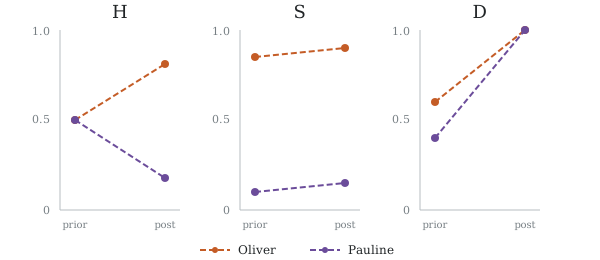
Imagine two people, Oliver and Pauline. They begin with the same degree of belief that vaccines are effective. Both then read the same scientific study reporting that vaccination works.
Oliver believes that the researchers are generally reliable. The study therefore increases his confidence in vaccination. Pauline believes that scientists tend to report false or misleading results. For her, the same report counts against the claim, and her confidence falls.
Their beliefs have polarised. They received the same information and updated according to the same probabilistic rules, but their different background beliefs gave the evidence different significance.
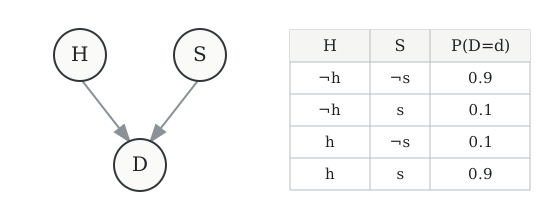
In the model, H represents the hypothesis that vaccines are effective, D represents the reported study result, and S represents the reliability of the scientists. Both agents learn the same evidence about D. Their different prior beliefs about S then lead them to update H in opposite directions.
Patterns of belief updating
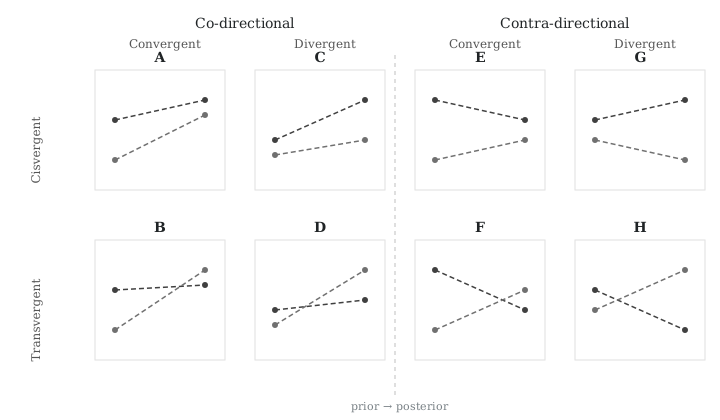
Agents can change their beliefs in several distinct ways. Three contrasts generate eight possible patterns:
- Convergent or divergent: do their beliefs move closer together or further apart?
- Co-directional or contra-directional: do both agents update in the same direction, or does one increase while the other decreases?
- Cisvergent or transvergent: do the agents retain their original ordering, or do their beliefs cross over?
Transvergence is not itself a form of polarisation, but it matters because some definitions of polarisation exclude cases in which the agents cross. The eight cases therefore distinguish phenomena that are easily conflated in ordinary discussion.
Why should rational agents not converge?
A familiar expectation in Bayesian epistemology is that rational agents exposed to the same evidence should eventually reach agreement. Bayesian merging results support that expectation under suitable assumptions, when agents receive sufficiently rich common evidence capable of settling the relevant questions.
The models studied here concern a different situation: the evidence is incomplete. The agents agree about which beliefs depend on which others, agree about the conditional probabilistic relationships between them, and receive the same evidence. They differ only in their prior degrees of belief.
Even under these demanding assumptions, particular beliefs can diverge. Rationality constrains how an agent should update from a given starting point; it does not guarantee that different starting points will generate the same response to incomplete evidence.
The evidence normally concerns a particular data node, whose effects then propagate through the rest of the belief network. That data node can itself encode compound evidence, such as several studies or reports considered together. The framework can also be extended to evidence received across several connected beliefs.
This result matters because standard explanations of polarisation are not sufficient. Bias, misinformation and selective exposure may explain many real cases, but eliminating them would not guarantee agreement. The models provide both a possibility result and a possible mechanism by which common evidence can deepen disagreement.
Belief networks and background beliefs
A joint probability distribution assigns probabilities to every possible combination of outcomes across a set of variables. A Bayesian network gives that distribution a more intelligible structure. Its nodes represent hypotheses or variables, while its directed edges encode conditional dependencies among them.
This matters because evidence rarely bears on one belief in isolation. Its significance depends on a wider system of beliefs about reliability, causation, institutions, instruments and other background conditions. When evidence enters one part of the network, its effects can propagate through these connections.
The agents in these models agree about the network structure and the conditional relationships among their beliefs. They differ only in their prior probabilities. The organisation of the network nevertheless allows those different starting points to generate distinct responses to common evidence.
The network structure also constrains which forms of updating are possible. Under the assumptions of the model, contra-directional and transvergent updating require particular relations of conditional dependence. Networks with fewer than three nodes cannot generate these phenomena. Rational polarisation is therefore not an automatic consequence of prior disagreement; it depends on the structure of the wider belief system.
Simulations show that the phenomenon is nevertheless general rather than confined to specially chosen numerical examples. Divergent updating appears even in simple networks, while contra-directional and transvergent updating become more common as networks grow more complex.
Criteria for polarisation
There is no single uncontroversial criterion for belief polarisation.
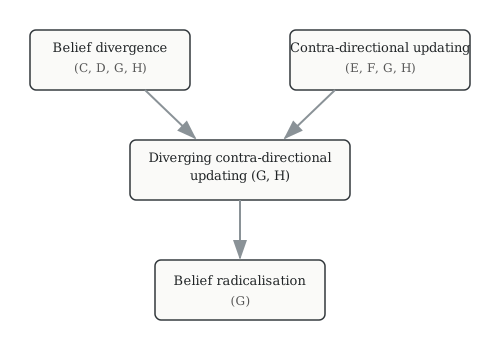
- Belief divergence requires only that the distance between the agents increase.
- Contra-directional updating requires that the agents move in opposite directions.
- Diverging contra-directional updating requires both.
- Belief radicalisation further requires the initially more confident agent to become still more confident while the initially less confident agent becomes less confident, without their beliefs crossing.
These are not four stages in one simple sequence. Belief divergence and contra-directional updating are distinct conditions, each of which is weaker than their conjunction. Belief radicalisation is a still more restrictive case.
No single criterion is correct for every purpose. The appropriate definition depends on whether we care about increasing distance, opposing directions of change, growing extremity, or some combination of these features.
From polarisation to factionalisation
Two-agent polarisation concerns whether particular beliefs move closer together or further apart. Factionalisation is a population-level phenomenon involving several beliefs at once.
Suppose that beliefs about vaccine efficacy and climate change both become more dispersed. This is polarisation. Now suppose that the same people who become sceptical about vaccines also tend to become sceptical about climate science, while another group becomes confident in both. The beliefs have become correlated across the population. Distinct packages of belief, or factions, have formed.
An underlying belief about the reliability of scientific institutions could connect the two issues. Agents who trust those institutions may move in one direction across both beliefs; agents who distrust them may move in the other. The resulting factions arise from the relations among beliefs, not merely from social influence or differential access to information.
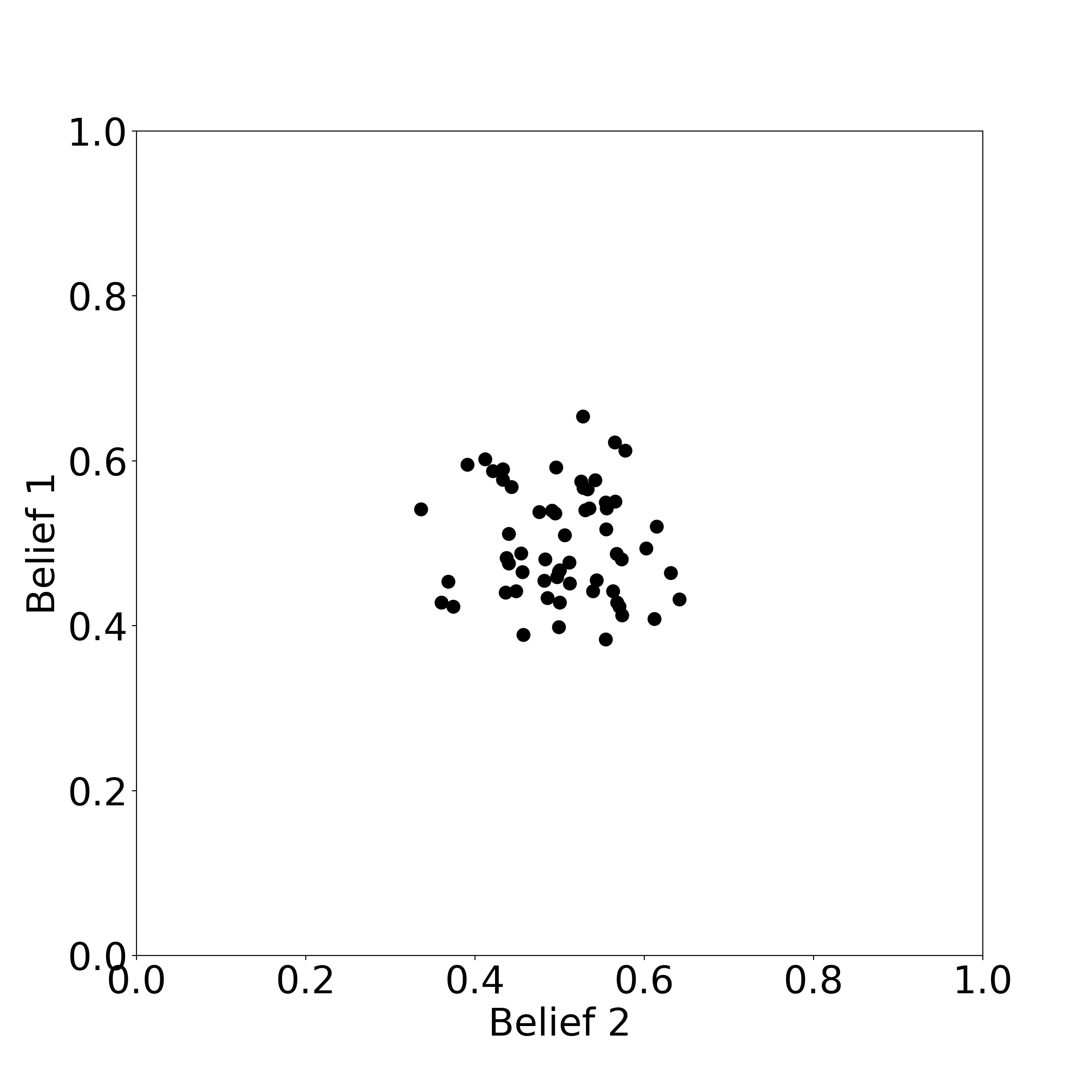 (a) Starting distribution.
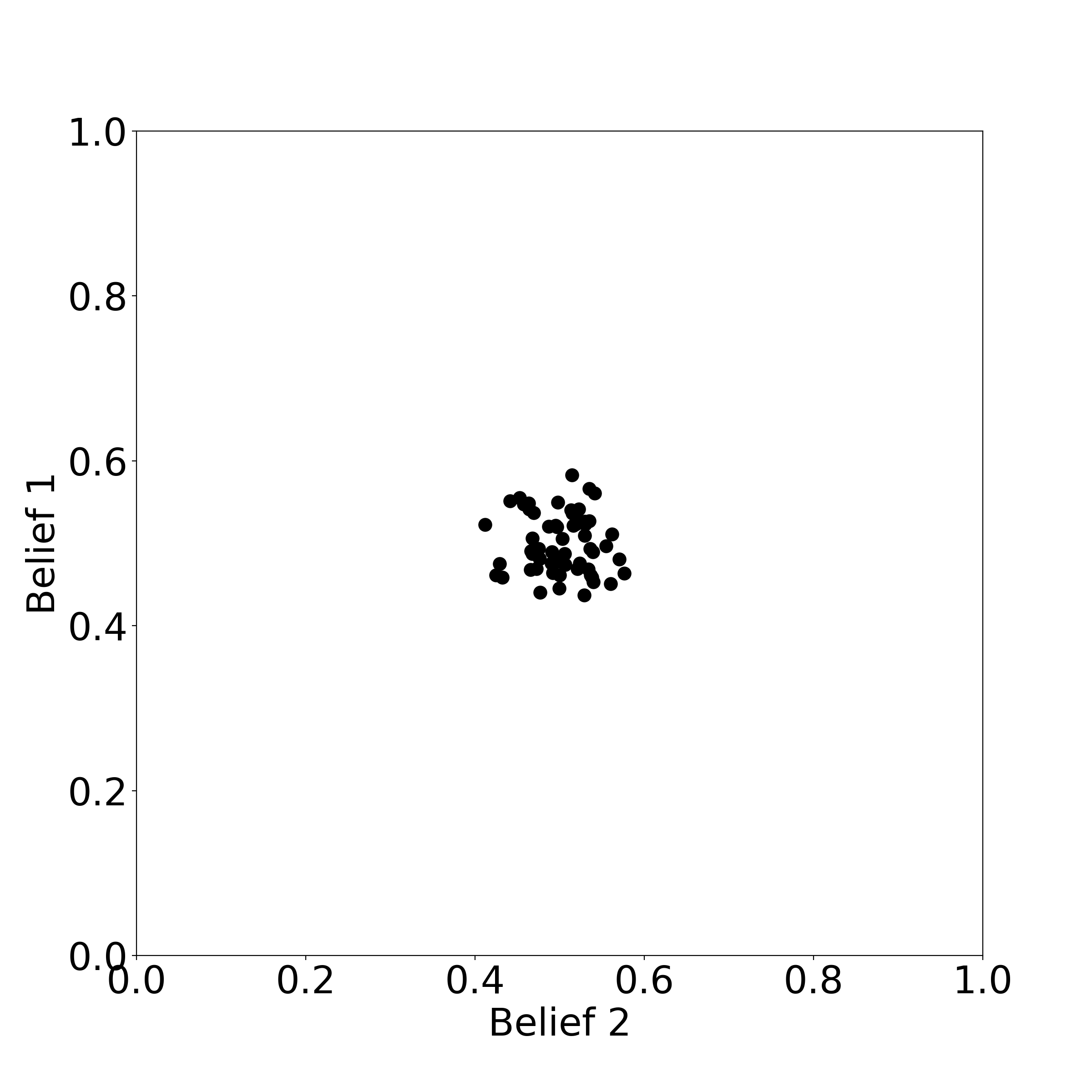 (b) Convergence: both beliefs move closer together.
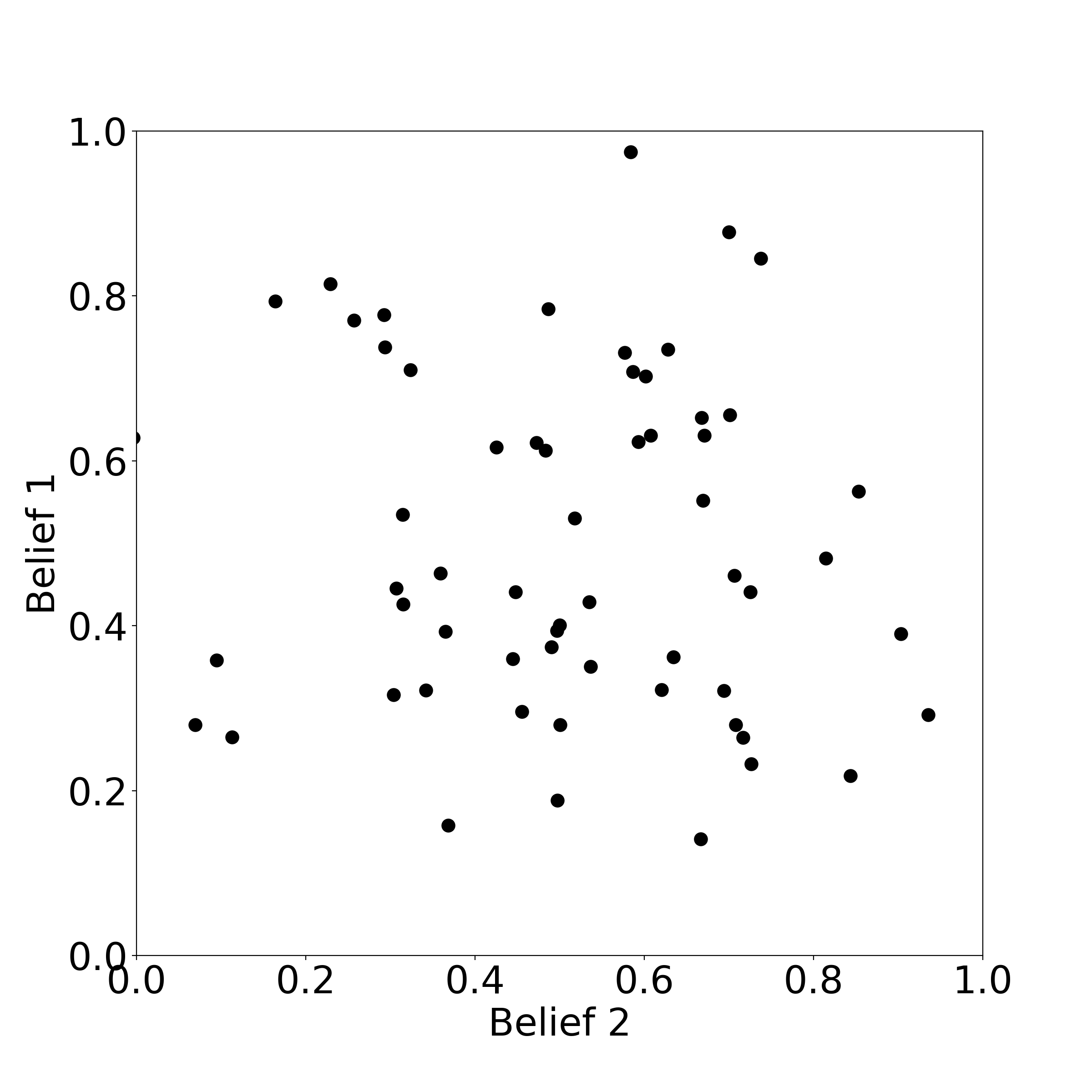 (c) General divergence: both beliefs spread without acquiring additional structure.
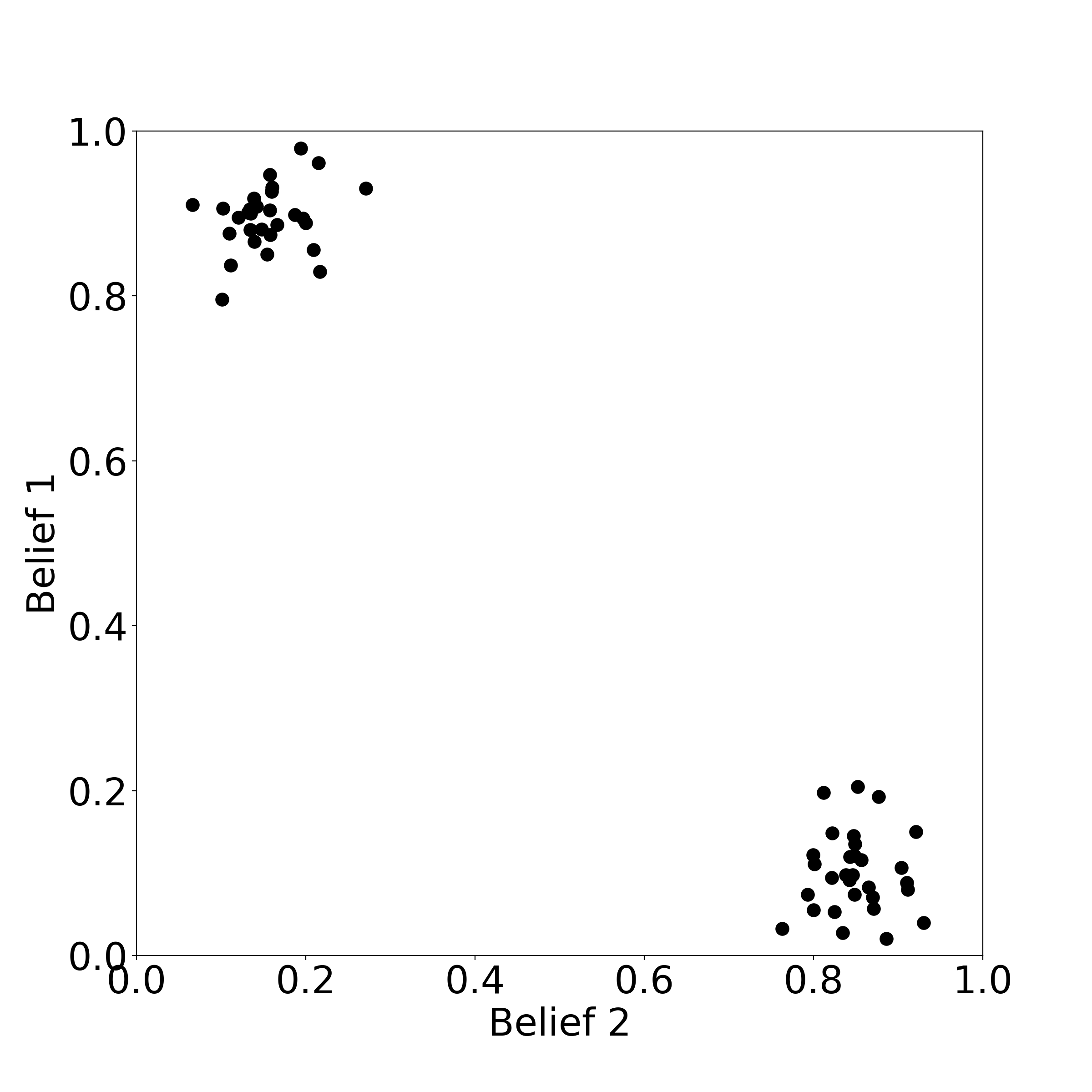 (d) Factionalisation: beliefs spread while becoming correlated.
Under the assumptions of the model, common evidence produces only two possible overall outcomes: convergence or factionalisation. General divergence is ruled out. If the population's individual beliefs spread out overall, that divergence must acquire correlational structure.
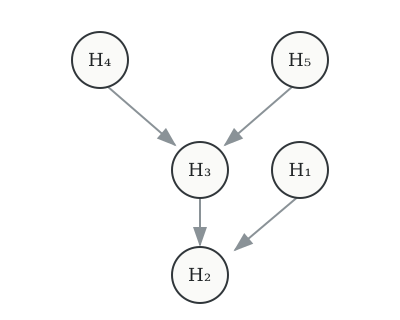 A five-variable belief network in which evidence propagates through several probabilistic dependencies.
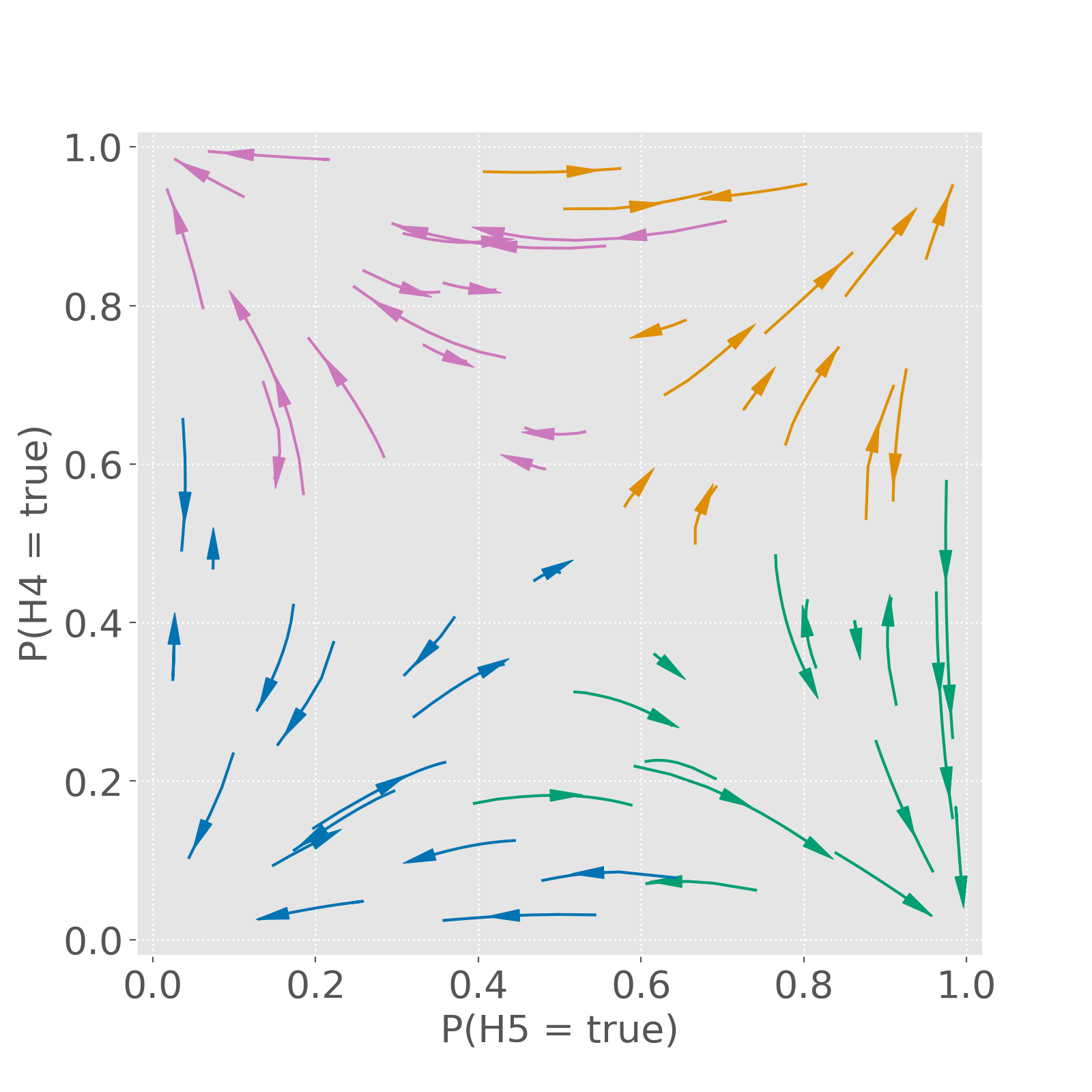 A representative simulation in which a population of sixty agents separates into four factions across a five-variable belief space.
Why factionalisation emerges
The result can be understood using information theory.
First, we can compare agents only by their probabilities for each individual hypothesis, ignoring the dependencies among those beliefs. Second, we can compare their complete joint probability distributions, which include the full structure connecting the hypotheses.
The Jensen-Shannon divergence provides a symmetric measure of information-theoretic distance between probability distributions. In the model:
- convergence occurs when the agents' individual beliefs move closer together;
- general divergence would require their individual beliefs to move further apart without their complete joint distributions moving closer;
- factionalisation occurs when the individual beliefs move further apart while the complete joint distributions move closer together.
Factionalisation is therefore simultaneously a form of divergence and a form of convergence. The agents separate when each belief is considered individually, but their complete probabilistic models become more similar once the relations among their beliefs are included.
As beliefs spread, they do not become arbitrarily disordered. The shared conditional structure forces them into increasingly informative relationships. Knowing where an agent stands on one issue becomes more useful for predicting where they stand on another. Disagreement becomes organised.
How should the result be interpreted?
A formal epistemologist might find the result reassuring. Even while individual beliefs polarise, the agents' complete joint probability distributions converge. In that sense, rational learning remains a process of epistemic coordination.
A social epistemologist may find the same result troubling. The population separates into groups that disagree across several issues at once. Each faction's beliefs may be internally coherent and mutually supporting, making it harder for further evidence or communication to bridge the divide.
The model does not claim that real polarisation has a single cause. Actual populations are also shaped by bias, misinformation, institutions, strategic communication and unequal evidence. The result is instead both a possibility theorem and a mechanistic model: removing those familiar problems would not, by itself, eliminate polarisation or factionalisation.
Sufficient common evidence capable of settling every relevant belief should ultimately produce convergence. Real agents rarely possess such complete evidence. Additional information about only one part of the belief network may instead reinforce the factions already forming.